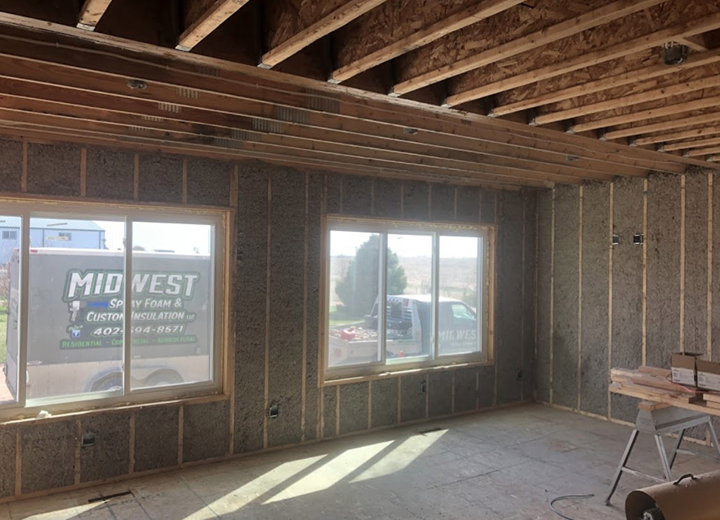
Both open and closed-cell spray foam start in the same gun, but they cure into very different materials — and choosing the wrong one for a given space is one of the most expensive mistakes a homeowner can make on an insulation project.
This guide breaks down what each does, where each shines, and what we recommend most often in Nebraska homes.
The 30-second version
- Closed-cell is dense, rigid, water-resistant, and gives you the highest R-value per inch. Use it in attics, roof decks, crawl spaces, basement rim joists, and anywhere moisture is a concern.
- Open-cell is softer, lighter, and cheaper per board foot. Use it in interior walls, sound-dampening applications, and in vented attics where moisture isn’t pushing against the foam.
Closed-cell, in detail
Closed-cell foam cures into a dense, rigid material with about a 2 lb/cu ft density. The closed cells trap a low-conductivity gas, which is why it delivers ~R-7 per inch — the highest of any common insulation. That density also makes it act as its own vapor retarder, so it doesn’t need a separate plastic sheet behind it.
In Nebraska, where January temperatures regularly drop below zero and summer humidity spikes, the moisture resistance matters. Closed-cell in a roof deck or crawl space stops the freeze-thaw cycles that cause sheathing rot and ice dams.
The downside: it costs about 40–60% more per board foot than open-cell, and it’s rigid enough that future plumbing or wiring changes require cutting it out rather than fishing through it.
Open-cell, in detail
Open-cell foam cures at roughly 0.5 lb/cu ft — about 1/4 the density of closed-cell. The open cell structure makes it softer (you can dent it with your finger), permeable to water vapor, and slightly lower R-value at about R-3.8 per inch.
What it gives up in rigidity it makes up in sound dampening. Open-cell is excellent in interior wall cavities between rooms, around media rooms, or in shared walls where airborne noise control matters. It’s also cheaper, so on a large vented attic where moisture isn’t a concern, you get more square footage covered for the same budget.
How we choose on a typical Nebraska home
For most residential projects, our default is a hybrid approach:
- Attic / roof deck: closed-cell, 3–4 inches against the underside of the sheathing. Stops ice dams, controls condensation, hits code R-value in less depth.
- Exterior walls (new construction or open studs): closed-cell flash coat plus open-cell fill, or all open-cell if budget is tight and the cavity is dry.
- Interior partition walls: open-cell for sound control.
- Crawl space / rim joist: closed-cell, always. Moisture barrier is non-negotiable here.
- Pole barns and shops: closed-cell against the metal. Stops condensation drips and adds structural rigidity to the panels.
Common myths
“Closed-cell is always better.” No — in interior walls where you want sound dampening, open-cell wins. Closed-cell in an interior wall is overkill and wastes money.
“Open-cell will absorb water.” Open-cell is vapor permeable, not water-absorbent. It doesn’t hold liquid water the way fiberglass does, but in spaces where vapor drive matters (crawl spaces, roof decks in our climate), you want closed-cell to act as the vapor retarder.
“I can mix products from different installers.” Foam-to-foam adhesion is generally fine if the substrate is prepped right, but warranty and manufacturer recommendations vary. Stick with one applicator per project.
The honest answer
Most Nebraska homeowners we work with end up with a combination, not one or the other. We’ll walk your space, look at where vapor and air leaks are happening, and recommend the right foam for each section. That’s what the free estimate is for — and we’re happy to do it without any pressure to commit.