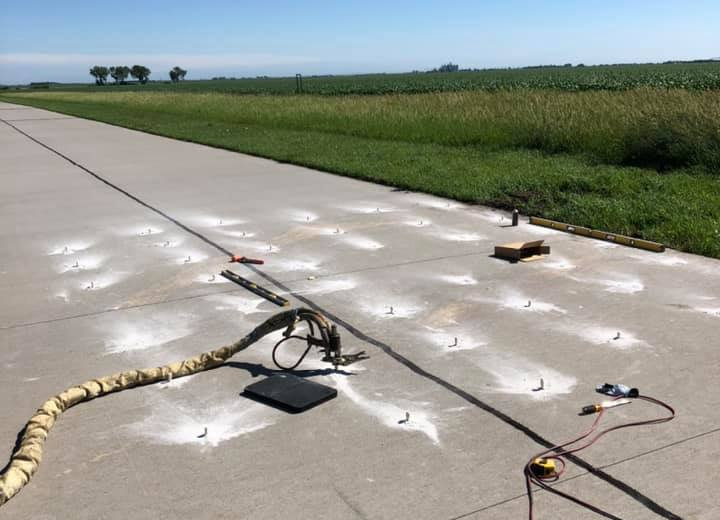
If a driveway corner has dropped two inches, or a sidewalk slab tilts toward the foundation, you have two real options: lift it back to grade with polyurethane foam, or tear it out and pour fresh concrete.
Lifting is dramatically cheaper, faster, and usually the right call. But not always. Here’s how to tell which side of the line your slab is on.
When lifting is the right call
- The slab is structurally sound — no major cracks, no spalling, no exposed rebar.
- The drop is relatively uniform across the slab, or limited to one corner / edge.
- You’re trying to fix a trip hazard, drainage problem, or aesthetic issue rather than the slab itself.
- The settling has stabilized (you’re not still actively losing ground).
For those cases, polyurethane lifting runs 50–80% less than replacement, is done in hours instead of days, and the slab is drivable the same afternoon.
When you should just replace
- The slab has through-cracks with significant separation — lifting one side will just open the crack wider.
- The surface is spalling, scaling, or showing exposed rebar. Lifting fixes elevation; it doesn’t fix a slab that’s already failing.
- You’re seeing active soil loss — erosion under the slab will keep happening regardless of how we lift.
- The slab was poured too thin or without rebar and is flexing under load.
We’ll tell you straight up at the estimate which side you’re on. We won’t lift a slab that should be replaced, and we won’t talk you into replacement when lifting would do.
What lifting actually involves
- We drill dime-sized holes through the slab at strategic points.
- We inject a two-part polyurethane foam through those holes. The foam expands, fills the void underneath, and lifts the slab back to grade in a controlled way.
- The foam cures in minutes. We patch the holes with color-matched grout. From a normal viewing distance, you can’t see where we worked.
Unlike old-school mudjacking (which used a heavy cement slurry), polyurethane is lightweight — it won’t recompact the soil beneath the slab the way slurry does. That’s why polyurethane lifts last decades while mudjacking often re-settles in a few years.
Common Nebraska scenarios we lift
- Driveway approaches dropping where they meet the street
- Sidewalk slabs tilted by tree root growth or seasonal frost heave
- Garage floors sloping toward the foundation
- Patio slabs settling away from the house (often water draining toward foundation)
- Shop floors and pole barn slabs
The honest tradeoff
Lifting is faster, cheaper, and less disruptive. Replacement gives you a brand-new slab with a brand-new lifespan. If your slab has another 15–20 years in it and you just need it level, lifting is the no-brainer. If the slab is already showing its age, putting money into lifting it is throwing good money after bad.
Send us a couple of photos or schedule a free estimate — we’ll tell you which one we’d do at our own house.